Three room conditions decide between flexible PVC skirting and standard vinyl wall base: moisture exposure, hygiene requirements, and traffic level. For wet or hygienic areas, choose coved flexible profiles with heat-formed corners. For fast renovation and retrofit work, choose self-adhesive skirting — but plan for a longer lead time. For every other commercial project, a standard flexible PVC skirting installed with a water-based contact adhesive is the dependable default. This guide covers the comparison table, specification quick table, installation methods, and a copy-ready RFQ checklist for your next inquiry.
Flexible PVC skirting and vinyl wall base are regional names for the same floor-to-wall finishing product: buyers in Southeast Asia and international markets usually call it flexible PVC skirting, while North American buyers use the term vinyl wall base. This guide uses flexible PVC skirting as the primary term — "flexible" refers to the soft, pliable PVC that bends to follow wall contours and heat-forms into seamless corners on site.
With traditional search traffic projected to decline by 25% by 2026 (Gartner, 2024) and roughly 58% of searches ending without a click (Ahrefs, 2024), commercial buyers — and the AI tools that summarise search results — expect a direct answer on the page. This guide is written to be quoted: every spec below matches what a supplier will confirm in a written quotation.
1. Why Skirting Matters in Commercial Projects
Skirting (wall base in US terminology) is the strip that finishes the joint between floor and wall. In commercial work it is not decorative: it hides the expansion gap, protects the wall base from scuffs and mops, and — in hygienic buildings — removes the crevice where dirt and bacteria collect.
The right choice depends on three room conditions:
| Room condition | Recommended type | Why |
|---|---|---|
| High moisture (kitchens, wet rooms, labs) | Cove profile (curved upstand) | The coved curve eliminates the 90° corner where water pools; heat-formed corners keep the joint continuous and water-tight |
| Strict hygiene (hospitals, cleanrooms, food prep) | Flexible PVC, heat-formed corners | Continuous, seam-free surfaces are easier to clean and disinfect |
| High traffic (corridors, schools, retail) | Standard flexible profile, 2.0 mm or 3.0 mm | Thicker profiles absorb impact at the wall base and resist scuffing |
A practical detail buyers often miss: match skirting to the flooring, not to a generic white/black range. When both come from the same colour system, the room reads as one installation and replacement batches stay consistent years later.
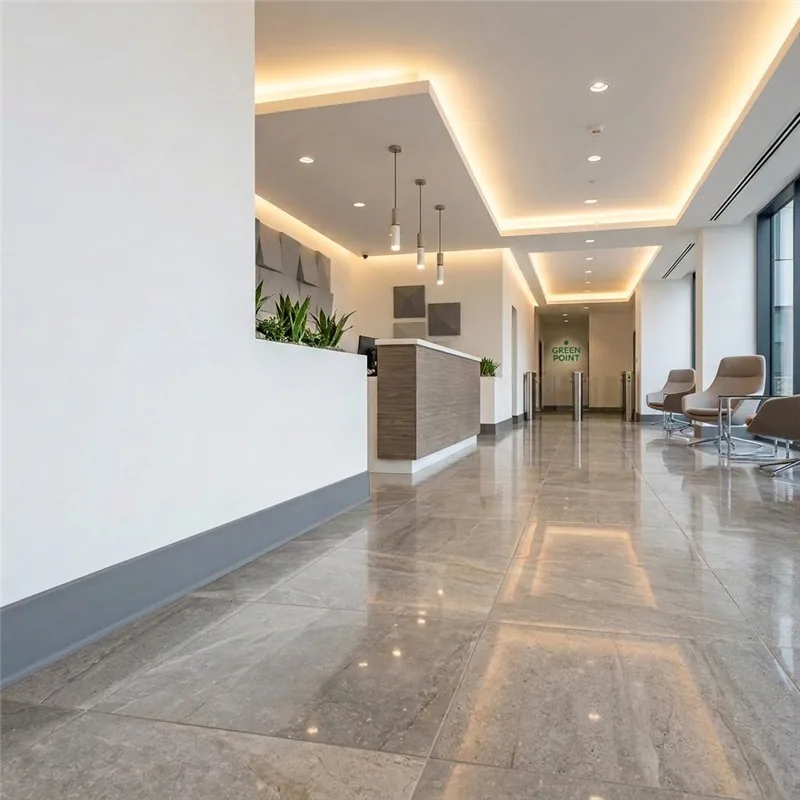
2. Types Comparison Table
| Flexible PVC (standard) | Cove former | Self-adhesive | |
|---|---|---|---|
| Installation | Water-based contact adhesive | Water-based contact adhesive | Peel-off backing, no adhesive needed |
| Best for | General commercial interiors | Hygienic and wet areas | Fast renovation, retrofit, existing floors |
| Corners | On-site heat-gun forming | On-site heat-gun forming | On-site heat-gun forming |
| Maintenance | Easy to clean, continuous finish | Easiest to clean (no 90° crevice) | Easy to clean; adhesion depends on wall surface |
| Cost range | Standard | Slightly higher (more material at base) | Comparable; higher if surface prep is needed |
| Lead time | In stock | In stock | +7 days to prepare (not stocked) |
Stock status matters: flexible and cove profiles ship within the standard 5–10 day lead time, while self-adhesive profiles are made to order and need roughly 7 extra days. If your project has a fixed site date, confirm stock status before committing to a type.
3. Specification Quick Table
| Product type | Flexible PVC skirting — standard / cove / self-adhesive |
| Models | H100 (100 × 2.0 mm, standard) · JH100 (100 mm slim-foot) · TA-3 (100 × 3.0 mm) |
| Heights | 60 / 80 / 100 / 120 mm (standard: 100 mm) |
| Thickness | 2.0 mm standard; 3.0 mm on TA-3 only |
| Colour | 200+ colour-matched options; custom RAL / Pantone available |
| Packaging | 2 m rigid lengths or 50 m flexible rolls |
| MOQ | Standard colour: 500 linear metres; custom colour: 1,000 linear metres |
| Lead time | 5–10 days (production capacity 3,000 m/day) |
| Samples | Fan deck sample chain, ~15 cm per swatch (not an A4 sheet) |
| Installation | Water-based contact adhesive / self-adhesive peel-off backing |
| Corner forming | On-site heat-gun forming (no separate corner fittings) |
Three notes on this table:
- Samples are fan decks, not A4 sheets — a chain of small swatches (about 15 cm each) covering the full colour range. State "fan deck" in your inquiry to avoid expectation mismatch.
- Custom colour MOQ doubles: standard colours start at 500 linear metres, a custom RAL or Pantone match at 1,000. Colour matching is done before production and confirmed against a physical sample.
- Heights and thicknesses are separate decisions. 100 mm is the commercial standard; 60 / 80 / 120 mm suit different wall conditions. Thickness is 2.0 mm standard; choose the 3.0 mm TA-3 for high-abuse corridors and wheelchair traffic.
4. Installation Methods
Method 1: Contact-adhesive method (recommended for permanent installation)
- Prepare the wall. Clean, dry, dust-free, free of grease or loose paint; prime porous or dusty surfaces where needed.
- Choose the adhesive by substrate. On porous substrates (drywall, plaster, concrete) a wet-set acrylic wall base adhesive may be used; on non-porous substrates (ceramic tile, metal, FRP, epoxy or painted surfaces) a water-based contact adhesive is required — run a bond test at least 72 hours before the main install on smooth or glossy surfaces.
- Apply. Coat the back of the skirting (and, for non-porous substrates, the wall surface as well), keeping the adhesive at least 1/4" (6 mm) from the top edge and aiming for 90%+ coverage.
- Bond. With contact adhesive, wait until it is dry to the touch, then press the profile into place — position it correctly before pressing, because contact adhesive bonds on contact and cannot be moved afterwards. With wet-set adhesive, bond within 15 minutes of application.
- Roll and cure. Roll with a hand roller in the direction of installation, then leave the installation undisturbed for 72 hours before cleaning or heavy use.
Do not use solvent-based neoprene adhesives: their solvents can migrate into soft PVC (swelling and softening), and they release fumes and are a fire hazard during application.
Method 2: Self-adhesive (peel-off backing)
The wall must be clean, dry, dust-free and smooth — self-adhesive profiles tolerate surface defects poorly. Peel off the release liner and press into place, working out air bubbles as you go. Adhesion drops in low temperatures, so keep the room above 15–18 °C during installation (general installation guidance). Self-adhesive is made to order and adds about 7 days to the lead time.
Method 3: On-site corner forming with a heat gun
Corners are formed on site with a heat gun — the profile is shaped directly around the corner, so no separate corner fittings are needed. Heat the corner section until the PVC softens (keep the gun moving to avoid whitening or scorching), wrap the profile around the corner, and hold until it cools and sets (about 10–30 seconds). The result is a continuous, joint-free corner — the detail that makes flexible PVC skirting worth specifying in hygienic buildings.
Handover check
Walk the installed runs before sign-off: no cracked corners, no lifting edges, no surface scratches, consistent colour within the same batch.
5. Buyer's RFQ Checklist
Send these eight points and you will receive a comparable quotation, with stock status and sample arrangement included:
- Height — 60 / 80 / 100 / 120 mm (state the standard you expect)
- Quantity — in linear metres
- Colour match — RAL / Pantone reference, or the flooring model it must match
- Packaging preference — 2 m rigid lengths or 50 m rolls
- Delivery requirement — target date, so the supplier can confirm stock vs. made-to-order
- Custom requirements — custom heights or colours (custom colour MOQ: 1,000 linear metres)
- Sample request — ask for the fan deck sample chain (~15 cm per swatch)
- Destination — port or country of delivery (optional but speeds up the logistics quote)
Trade note: flexible PVC skirting typically falls under HS code 392590 — confirm the classification with your freight forwarder or customs broker before shipping.
6. Common Mistakes
- ❌ Using solvent-based neoprene contact adhesive. Its solvents can migrate into soft PVC, causing swelling and softening, release fumes on site, and pose a fire hazard during application. ✅ Use a water-based contact adhesive — it delivers the same press-to-bond, high initial tack as a contact adhesive without solvent risks. Note that wet-set acrylic "flooring-style" adhesives lack the initial tack skirting needs; use them only on porous substrates (drywall, plaster, concrete), and switch to a contact adhesive on non-porous substrates (ceramic tile, metal, FRP, epoxy or painted surfaces).
- ❌ Gluing onto unprepared walls. Dust, loose paint or damp plaster means the profile peels off within weeks. ✅ Prime and dry the substrate first.
- ❌ Overheating corners with the heat gun. Holding the gun still scorches and whitens the PVC. ✅ Keep the gun moving and let the softened profile cool in position.
- ❌ Ignoring batch colour differences. Two batches can differ slightly even in the same colour code. ✅ Order the full project quantity in one batch and confirm against a physical sample.
7. FAQ
Q1. Is flexible PVC skirting the same as vinyl wall base?
Yes — they are regional names for the same floor-to-wall finishing product. Buyers in Southeast Asia and international markets usually call it flexible PVC skirting, while North American buyers use the term vinyl wall base. "Flexible" refers to the soft, pliable PVC that bends to follow wall contours and can be heat-formed on site to create continuous, seamless corners. This guide treats the two terms as synonyms.
Q2. What heights and thicknesses are available?
Available heights are 60, 80, 100 and 120 mm, with 100 mm as the standard. Standard thickness is 2.0 mm; a 3.0 mm version (model TA-3) is available at 100 mm height for higher-abuse areas. Core models: H100 (100 × 2.0 mm standard), JH100 (100 mm slim-foot design) and TA-3 (100 × 3.0 mm).
Q3. How are inside and outside corners handled?
Both inside and outside corners are formed on site with a heat gun: the skirting is heated until pliable, shaped around the corner, then held until it cools and sets. This produces continuous, joint-free corners. No separate corner fittings are required.
Q4. Can skirting be colour-matched to flooring?
Yes. GREEN POINT skirting offers 200+ colour-matched options coordinated with UNITECH NEXUS flooring, and custom colours can be matched to RAL or Pantone references for project-specific requirements.
Q5. What is the MOQ for custom colours?
Standard colours: 500 linear metres; custom colours: 1,000. Colour sample chains (fan decks, about 15 cm per swatch) are provided for approval before production; standard lead time is 5–10 days.
8. Conclusion: Your Decision Path
Match the room to the profile: wet or hygienic areas → coved flexible profiles; fast retrofit → self-adhesive (with the +7 day lead time); everything else → standard flexible PVC skirting with a water-based contact adhesive. Choose 100 mm as your default height, confirm stock in writing, order one batch, and ask for the fan deck before you commit.
GREEN POINT flexible PVC skirting is produced by Shanghai Unitech Plastic Co., Ltd. and colour-coordinated with UNITECH NEXUS flooring. For a quotation with stock status and samples, send your project details through the contact form with the checklist above — our team will confirm specs, lead time and freight options for your destination. Browse the flexible PVC skirting profiles or the standard PVC skirting range to shortlist models before you ask.
Related reading: How to Install PVC Sheet Flooring: A Complete Step-by-Step Guide · Hot-Air Welding for Vinyl Flooring · Flexible PVC Skirting for Floor-to-Wall Junctions