Electronics & Labs

ESD Anti-Static Vinyl Flooring

Static dissipative homogeneous PVC flooring. Surface resistance 10^6-10^9 Ω (IEC 61340-4-1). Protects sensitive electronics from electrostatic discharge. IEC 61340-5-1 compliant. BS 476 Class 1 fire-rated.

Request a Quote

UNITECH NEXUS ESD flooring is supplied as sheet and roll as standard. For projects that specify a modular format, an ESD tile of 600 × 600 mm × 2 mm is also available. Tiles are laid on a copper foil grid at 600 mm centres with conductive adhesive, earthed at the points confirmed by the electrical contractor, and measured the same way as the sheet — EN 1081 or IEC 61340-4-1.

Product Overview

UNITECH NEXUS ESD (Electrostatic Discharge) anti-static vinyl flooring is a specialised homogeneous PVC sheet formulated with conductive carbon particles distributed throughout the full thickness. Unlike surface-coated anti-static treatments, the conductivity is permanent — it cannot wear off or be cleaned away.

Designed for environments where uncontrolled electrostatic discharge can damage sensitive electronic components, ignite flammable materials, or disrupt precision instruments. Surface resistance is controlled between 10^6and10^9 Ω (ohms), meeting IEC 61340-5-1 requirements for EPA (Electrostatic Protected Area) flooring.

Key Features

  • Permanent static dissipative properties — full-thickness conductivity
  • Surface resistance: 10^6-10^9 Ω (IEC 61340-4-1)
  • Body voltage generation: <100V (IEC 61340-4-5)
  • Heat-welded seamless joints with conductive welding rod for full ESD continuity
  • BS 476 Class 1 fire rating
  • EN 660-2 Group T abrasion resistance
  • Chemical resistant — withstands IPA and solvent cleaning
  • Available in 2.0mm thickness
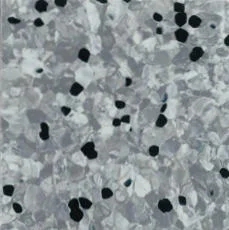
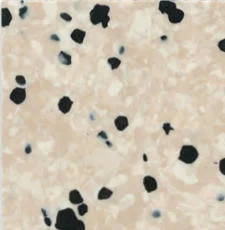
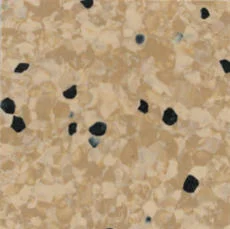
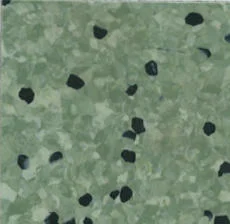
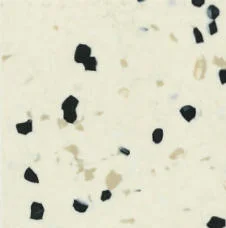
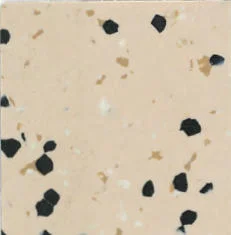
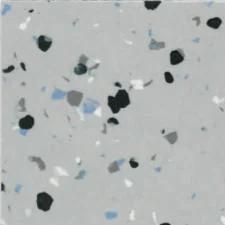
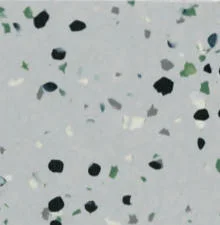
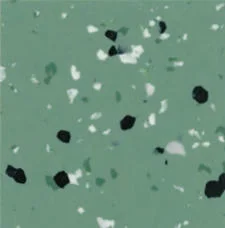
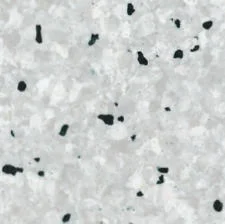
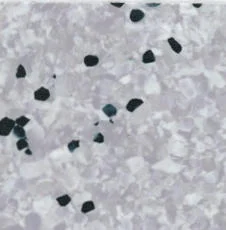
  • 15 in-stock colours; custom colour matching available on request

Copper grounding strip included

Complete grounding system included. Each installation includes a full ESD grounding kit: self-adhesive copper grounding tape (25 mm × 0.05 mm) laid in a grid pattern beneath the flooring, conductive adhesive for full-bond electrical continuity, conductive PVC welding rod at all seams, and a connection to a common earth point / building ground busbar. This ensures uniform charge dissipation across the entire floor area.
Technical Specifications

Physical Properties
Total Thickness2.0 mm (EN ISO 24346)
Wear LayerN/A (full-thickness conductivity)
Roll Width2.0 m (standard)
Roll Length20 m per roll
Weight~3.0 kg/m²
Dimensional Stability≤0.25% (EN ISO 23999 (EN 434))
FlexibilityNo cracking at Ø20 mm mandrel (EN ISO 24344)
Indentation Resistance≤0.10mm (EN ISO 24343-1 (EN 433))
Performance & Electrical
Surface Resistance Rg10^6-10^9 Ω (IEC 61340-4-1)
Vertical Resistance Rv≤10^9 Ω (IEC 61340-4-1)
Body Voltage<100V (IEC 61340-4-5)
Walking Test<100V (IEC 61340-4-5, 23°C/25%RH)
Fire RatingBS 476 Class 1 / EN 13501-1 Bfl-s1
Slip ResistanceR10 (DIN EN 16165)
Abrasion ResistanceEN 660-2 Group T
VOC EmissionsLow VOC

Colour Chart

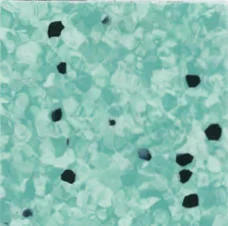
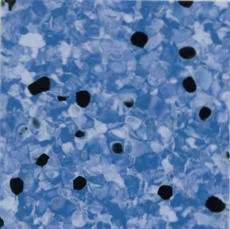
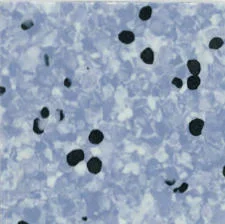
15 in-stock colours. Custom colour matching available on request.

5501
5501
5502
5502
5503
5503
5505
5505
5506
5506
5507
5507
5508
5508
5509
5509
5510
5510
5511
5511
5513
5513
5516
5516
5517
5517
5518
5518
5519
5519

Need a custom colour? OEM colour matching available. Request samples →

Verification

How the Resistance Is Specified and Checked

A conductive floor is one link in a grounding path. What the client accepts at handover is the reading of the whole path, so the specification and the test method have to be agreed before the flooring goes down.

System resistance limit≤ 3 × 10⁵ Ω stated against JC/T 550-2019. We publish the limit, not site readings: the figure at handover belongs to the finished system.
When to measureAfter the conductive adhesive has fully cured (allow at least 16 h) and with the room at its service temperature and humidity. Measuring early reports the adhesive, not the floor.
How to measureWith an instrument and electrode arrangement that match the standard the project is specified against, not with a general-purpose multimeter.
Re-verificationAnnual check under IEC 61340-5-1, as part of the site's ESD control programme. Cleaning agents and floor finishes applied later are the usual cause of drift.
Who owns which partAdhesive, copper strip and earth terminal are built by different trades. See who answers for each part of the path before the test, not after it fails.

A reading outside the limit does not identify the floor as the cause. Check the instrument and test voltage first, then continuity from strip to terminal, then the continuity of the adhesive film.

Frequently Asked Questions

How is ESD flooring grounded?

Self-adhesive copper grounding tape (25 mm x 0.05 mm) is laid in a grid pattern beneath the flooring and connected to a common earth point or building ground busbar. Each installation includes copper tape. A qualified electrician must verify the grounding connection.

Does the anti-static property wear off over time?

No. UNITECH NEXUS ESD flooring uses conductive carbon particles distributed throughout the full thickness of the material. Unlike surface-coated anti-static treatments, the conductivity is permanent and cannot wear off, be cleaned away, or degrade with foot traffic.

What is the difference between static dissipative and conductive flooring?

Static dissipative flooring has surface resistance between 10^6 and 10^9 ohms, safely bleeding static charges at a controlled rate. Conductive flooring has resistance below 10^6 ohms, providing faster discharge. UNITECH NEXUS ESD flooring is static dissipative, sitting within this range at 10^6-10^9 ohms, fully compliant with the IEC 61340-5-1 EPA (Electrostatic Protected Area) range of 10^6-10^9 Ω.

How do you test ESD flooring after installation?

Testing follows IEC 61340-4-1 using a surface resistance meter with a 2.5 kg electrode. Measurements are taken at multiple points across the floor. Acceptable range is 10^6-10^9 ohms for static dissipative flooring. Body voltage generation testing (IEC 61340-4-5) should also be performed.

Can ESD flooring be installed in cleanrooms?

Yes. UNITECH NEXUS ESD homogeneous vinyl is suitable for ISO Class 7 and Class 8 cleanrooms (ISO 14644-1). The heat-welded seamless surface prevents particle entrapment. The flooring resists IPA and common cleanroom disinfectants. For higher cleanliness classes, consult our technical team.

What is ESD flooring and how does it work?

ESD (electrostatic discharge) flooring safely drains static electricity from people, trolleys and equipment to earth, protecting sensitive electronics from discharge damage. Conductive and static-dissipative vinyl grades are classified by surface resistance under IEC 61340-5-1 and EN 1081. Typical areas include electronics production, laboratories, server rooms and healthcare ESD zones.

What is the minimum order quantity (MOQ) for PVC flooring?

Our standard MOQ is 500 m² per colour. Colours are counted separately, so a project that uses three colours normally means three minimum quantities. For project specifications, OEM colours or first trial orders, MOQ can be negotiated — tell us your colour split and quantity and we will confirm what is possible in writing. Lead time: for standard flooring orders, production takes about 7–10 days from written confirmation of the specification. Project quantities and special colour matching are confirmed order by order. We quote FOB Shanghai.

Do you supply conductive (EC) class ESD flooring?

Yes. A conductive grade is available on request, classified 10⁴–10⁶ Ω by the same EN 1081 resistance measurement as our dissipative range (10⁶–10⁹ Ω). It is installed as a system — conductive adhesive, copper earthing tape, conductive welding rod and a verified earth point — and performs only when bonded to earth. These figures describe the material classification, not the finished installation: the installed floor is verified on site per IEC 61340-4-1. Send us the target band and the application and we will confirm the suitable grade.

📄 Product Brochure

Download the complete product datasheet with specifications, installation guide, and colour charts.

Download PDF Brochure

Complete Your Flooring System

Wall Protection → Cove Former → Capping Strip →

Related Variants

Report-backed values are third-party tested (Intertek, SGS) and published on our Test Reports page. Other classifications are product-performance data supported by in-house laboratory testing and are available on request.

ESD Anti-Static Flooring: How to Choose


Further reading on this site: · ESD Flooring for Clean Rooms and Electronics Facilities: Specification Guide


Further reading on this site:

Request a Sample & Technical Datasheet

We'll send an ESD test report and A4 sample for your evaluation. MOQ 500 m².

Request Now Chat on WhatsApp