ESD Flooring

ESD Antistatic Flooring

ESD antistatic flooring for electrostatic discharge control in electronics, cleanrooms and sensitive areas.

Request a Quote

Product Overview

UNITECH NEXUS ESD antistatic flooring dissipates static charge from people and equipment through a conductive network integrated throughout the full thickness, connected to earth via conductive adhesive and copper tape. Its resistance (10⁶–10⁹ Ω, IEC 61340-4-1) protects sensitive components without depending on humidity.

Available in dissipative (SD) and conductive (EC) versions. Antibacterial PUR surface, easy to clean and repair. Ideal for electronics manufacturing, laboratories and data rooms.

Key Features

  • Dissipative (SD) and conductive (EC)
  • Resistance 10⁶–10⁹ Ω (IEC 61340-4-1)
  • Humidity-independent
  • Full-thickness conductive network
  • Antibacterial PUR
  • Bfl-s1, R9/R10

ESD Flooring →

Technical Specifications

Electrical Properties
TypeDissipative / conductive (EC and SD)
Electrical resistance10⁶ – 10⁹ Ω (IEC 61340-4-1)
Charge generationHumidity-independent
Earth connectionConductive adhesive + copper tape
Performance
Fire reactionEN 13501-1 Bfl-s1
Slip resistanceR9 / R10 (DIN EN 16165)
AntibacterialYes (PUR treatment)
ApplicationCleanroom, laboratory, electronics

ESD Flooring in the Electronics Industry

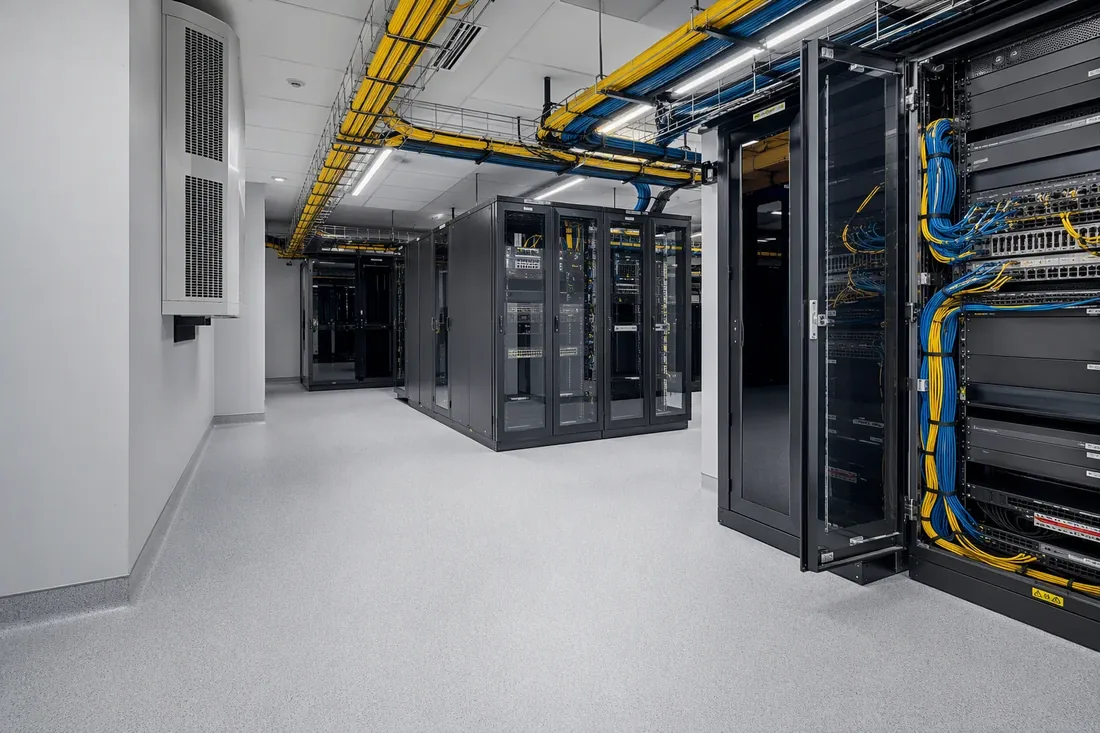
In electronics plants, data centers and workshops, UNITECH NEXUS ESD flooring controls the electrostatic charge that damages sensitive components.

Assembly Lines

Component assembly lines where a single discharge can destroy microchips.

Data Centers

Server rooms requiring earthing and discharge-free conditions.

Repair Workshops

Technical services and calibration laboratories with sensitive equipment.

For controlled environments see the cleanroom flooring page (ES) and laboratory ESD flooring page (ES).

Electrostatic Control Parameters
Electrical resistance10⁶ – 10⁹ Ω (IEC 61340-4-1)
TypeDissipative / conductive (EC and SD)
Fire reactionEN 13501-1 Bfl-s1
EarthingConductive adhesive + copper tape

FAQ

What is the difference between ESD and antistatic?

Antistatic describes the material: it limits charge generation (EN 1815, ≤ 2.0 kV). ESD is a control system: IEC 61340-5-1 governs the whole protected area, not one product. Our flooring sits in the dissipative class, and the figure that counts is measured on the installed floor, below 1 × 10⁹ Ω to earth.

Does it protect 30 V components?

Yes, as long as the earthing chain is intact. The conductive network drains charge to the building earth, so surface voltage stays under the threshold that damages 30 V devices. Treat the reading as a system value: it depends on the flooring, the adhesive, the copper tape and the earth connection, measured to earth per IEC 61340-4-1.

Is ESD footwear required?

Not for the floor to work, but yes for a complete EPA. Floor resistance and the person system are two separate requirements: IEC 61340-5-1 also sets the combination of person, shoe and floor below 3.5 × 10⁷ Ω, measured by the IEC 61340-4-5 method. With ordinary footwear the floor still reduces charge; it just does not guarantee personnel grounding.

Is flooring alone enough for IEC 61340 compliance?

No single material is ever enough. IEC 61340-5-1 is a system requirement: the floor is the foundation, but compliance also needs an earthing network bonded to the building earth, conductive adhesive at the joints, suitable footwear, chairs and wrist straps, and a documented measurement on the finished floor. We supply the flooring system and can advise on the earthing layout.

Related Variants

Report-backed values are third-party tested (Intertek, SGS) and published on our Test Reports page. Other classifications are product-performance data supported by in-house laboratory testing and are available on request.

ESD Anti-Static Flooring: How to Choose

📄 Product Brochure

Download the complete product datasheet with specifications, installation guide, and colour charts.

Download PDF Brochure

Related guide: ESD Anti-Static Flooring: Complete Guide to Standards, Installation & Selection

Four details get you a quoted price

  • Specification — product line, thickness, roll or plank size, colour reference
  • Quantity — total square metres, and whether it ships in one lot or in phases
  • Destination — port or city, so we can quote FOB or CIF
  • Delivery window — the date the material has to be on site

Send these four by email or WhatsApp and we reply with a technical data sheet and a firm price. With fewer details we can only quote a range.

Request a Quote

Explore our full UNITECH NEXUS range. Free samples shipped worldwide.

Request samplesChat on WhatsApp